
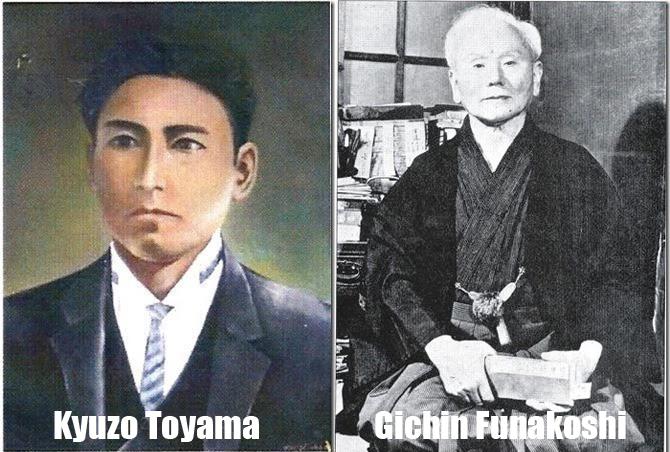
Two Okinawans who helped change the world were born not only the same year and the same month, but almost on the same day. Kyuzo Toyama, known as the “Father of Okinawan Immigration,” was born on November 9, 1868, in Kin, Okinawa. Gichin Funakoshi, known as the “Father of Modern Karate,” was born on November 10, 1868, in the Yamakawa district of Shuri, Okinawa.
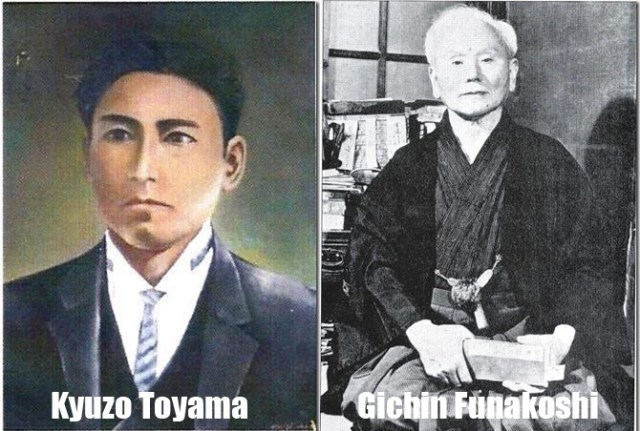
Both Kyuzo Toyama and Gichin Funakoshi started out as teachers.
Kyuzo Toyama was such a bright student, he completed the compulsory four years of elementary school in two years. In 1884 at age 16, he entered the Okinawa Normal School for teachers on scholarship, graduating in 1889. In 1893, at age 25, he became principal of Kin Elementary School. However, because he felt that he and his school were being treated unfairly by the Japanese education system, he resigned his post. After leaving, he became head of Namisato Ward in Kin, where he worked to find a new site for the Kin Elementary School and pursued several other improvement projects for the village. Some people opposed Toyama’s efforts and took physical action against him. Because of these unpleasant experiences, he ended up living in a cottage in the mountains working as a farmer and studying at night (Hijirida & Oshiro, ch. 2).
In 1896 at age 29, Toyama decided to go to Tokyo to continue his studies and to seek solutions for Okinawa’s problems (Hijirida & Oshiro, ch. 2).
Gichin Funakoshi was born premature and was sickly as a child. While growing up, his grandfather on his mother’s side began teaching him the Chinese classics. While attending elementary school, he became friends with the son of Yasutsune Azato who was a noted karate master. In 1879, after Azato’s son introduced Funakoshi to his dad, the 11-year-old became Azato’s student. Through diligent karate training, Funakoshi’s health improved. Besides karate, Funakoshi also had many conversations about the Chinese Classics with his karate teacher. And because of his studies in the Chinese classics with both his grandfather and Azato, he decided to pursue a teaching career. Funakoshi considered himself a Confucian scholar (Funakoshi). Continue reading →









 liuchiuan